

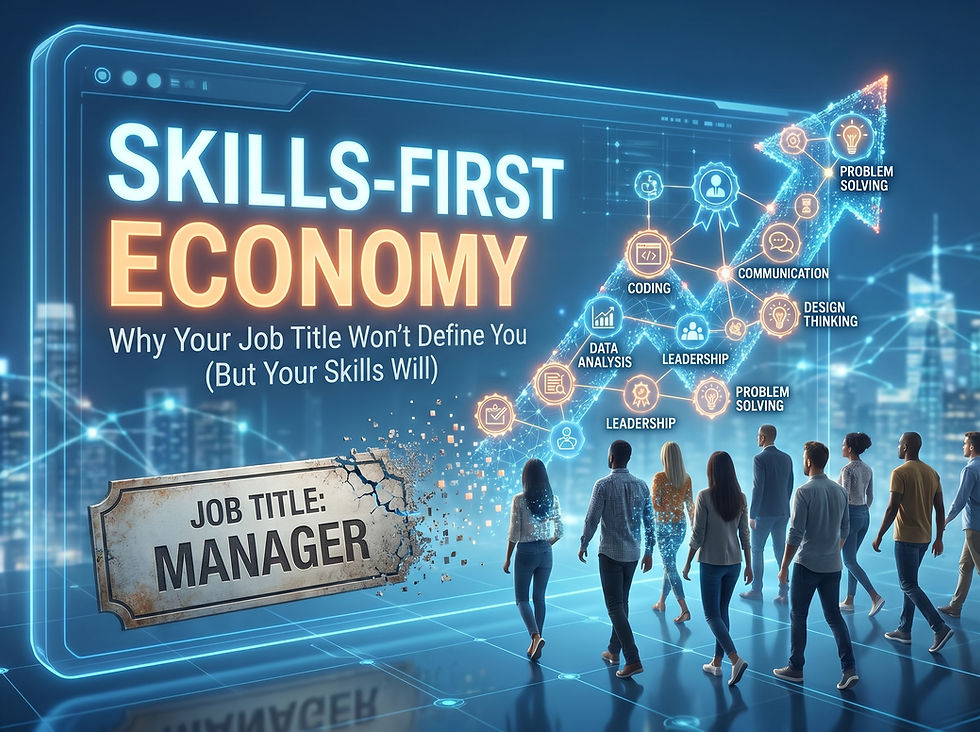
Skills-First Economy – Why Your Job Title Won’t Define You (But Your Skills Will)

If you’re entering the workforce today, here’s the reality:
Your degree won’t carry you.
Your job title won’t protect you.
Your experience alone won’t differentiate you.
Your skills will.
India is moving toward a skills-first economy. But most workplaces are still stuck in a role-first mindset.
That gap is where frustration—and opportunity—both exist.
What’s Changing (And Why It Matters to You)
Organizations are no longer asking: 👉 “What role are you in?”
They are starting to ask: 👉 “What can you actually do—and how well?”
Because business today needs people who can:
Solve problems
Adapt fast
Handle real situations
Deliver outcomes consistently
Not just “fit into a job description”.
The Reality You’ll Face at Work
You might be hired as:
A marketing executive
A sales associate
A management trainee
But your day will demand more:
Analyze data
Handle clients
Make decisions
Collaborate across teams
Use tools you were never trained on
This is where most fresh talent struggles.
Not because they lack potential— but because they were never built for applied performance.
What Will Actually Set You Apart
In a skills-first economy, three things matter:
1. Can You Apply What You Know?
Knowing concepts is not enough.
Can you:
Handle a real client conversation?
Solve a messy problem with incomplete information?
Make decisions under pressure?
Because that’s what work looks like.
2. Can You Learn While Working?
The fastest-growing professionals are not the ones who:
Know the most
But the ones who:
Learn in real time
Adapt quickly
Improve with every task
Learning is no longer a phase. It is part of your daily work.
3. Can You Deliver Outcomes Consistently?
Effort is not the metric anymore.
Workplaces value:
Results
Reliability
Execution quality
If you can deliver consistently, you become valuable—fast.
What Businesses Actually Need From You
Let’s make this clear.
Organizations don’t need:
More degrees
More certificates
More theoretical knowledge
They need people who can:
Contribute from Day 1
Take ownership
Improve performance over time
That’s the shift.
Where Most Gen Z Gets Stuck
Not in capability— but in approach.
Common gaps:
Waiting to be trained instead of figuring things out
Focusing on tasks, not outcomes
Avoiding difficult conversations or decisions
Expecting clarity in situations that require judgment
Workplace success is not about comfort. It’s about capability under real conditions.
What You Should Start Doing Now
If you want to stay ahead, focus on this:
Build Skills That Show Up in Work
Communication in real situations (not scripted)
Problem-solving with constraints
Decision-making with accountability
Seek Real Practice, Not Just Learning
Internships
Live projects
Simulations
Anything that puts you in real scenarios
Ask Better Questions
Instead of: 👉 “What is my role?”
Start asking: 👉 “What problem am I solving?” 👉 “What outcome is expected from me?”
Vision 2030 – Where You Fit In
India’s growth story depends on one thing:
👉 A workforce that can perform, not just qualify
This is your moment.
Because Gen Z has:
Access to tools
Exposure to change
Ability to adapt faster than any previous generation
But advantage only matters if it is used.
Every Day, Every Move Counts
The skills-first economy is not coming in 2030.
It is already here.
And it is shaped by:
What you choose to learn
How you approach your work
The standards you set for yourself
Every day, every move either: 👉 Builds your capability or 👉 Keeps you replaceable
Final Thought
You don’t need to wait for the “right role”.
You need to become the person who can perform in any role.
A Question You Can’t Ignore
If your job title was taken away today, what skills would still make you valuable—and can you prove it through your work?


Comments